




Cutting and die-cutting
At Protra Group, we offer precise and efficient cutting and die-cutting of a wide range of materials – from flexible textiles to more robust and technical materials. With modern equipment and a strong process understanding, we ensure consistent quality and high repeatability, whether it involves prototype development or large-scale series production.
We work with both digital cutting and classic die-cutting, and we always advise on the method that best matches the product’s requirements for tolerances, complexity, and volume. Digital cutting is ideal for flexible production where there may be a need for quick adjustments, small series, or complex geometries without tooling startup costs. Die-cutting, on the other hand, is a highly efficient solution for larger series where high speed and consistency are required – here, we develop custom-made cutting dies that ensure precise and stable results throughout the entire production run.
Cutting and die-cutting are often a central link in the overall production, and at Protra Group, we view them as an integrated part of the whole. We work closely with our other departments to ensure that the cut items are optimized for subsequent processes such as sewing, assembly, or welding. This ensures efficient production and a well-crafted end product where all parts fit together precisely.
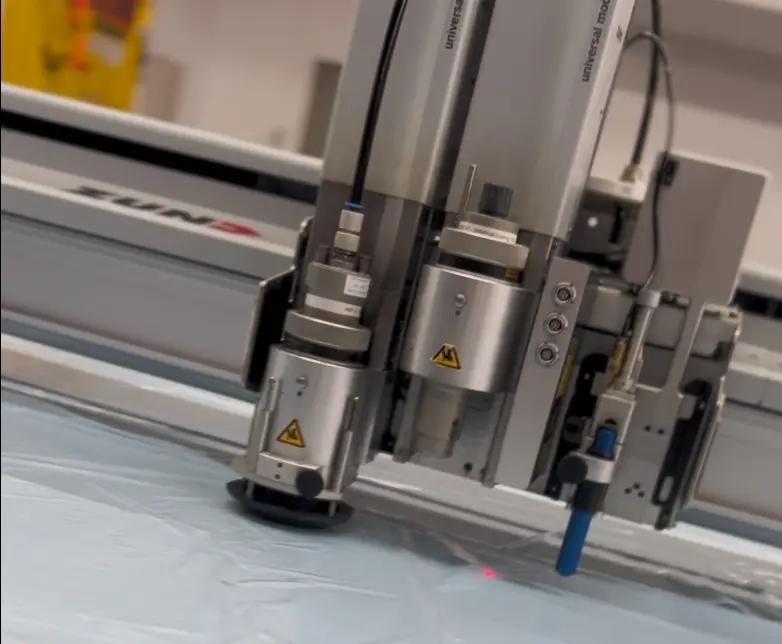
Our production includes an advanced cutting machine from Zünd, which provides great flexibility in terms of materials, formats, and material thicknesses. This means fast changeovers, minimal material waste, and sharp, precise cuts.
Zünd is a Swiss manufacturer of flatbed cutting machines that are digitally controlled via software. The machine works with interchangeable tools and can therefore be adapted to many different tasks and material types. It typically works in conjunction with CAD drawings, allowing for direct cutting from digital files with very high precision.
The machine can, among other things:
- Cut complex shapes with great accuracy – even in thick or technical materials
- Handle many material types, such as textiles, leather, foam, plastic, rubber, cardboard, and composite materials
- Change tools, allowing it to cut, mill, score, or perforate
- Optimize material consumption via nesting (intelligent placement of parts), which reduces waste
- Increase productivity, as it can work quickly and repeat precise cuts in series